
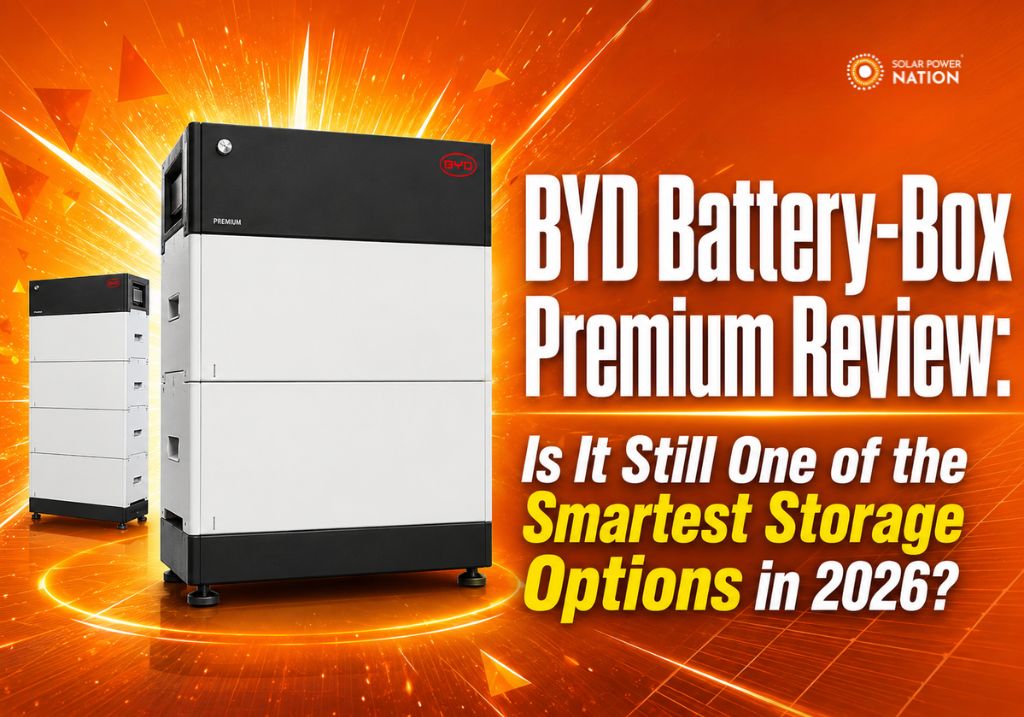
BYD isn’t a new name in Australian solar. It’s been one of the most-installed home battery brands in the country for years, largely off the back of the Battery-Box range — a modular lithium iron phosphate (LFP) system that’s earned a reputation for being solid, well-documented, and easy for installers to work with. If you’ve been comparing batteries for more than five minutes, you’ve almost certainly seen it come up.
This isn’t a sponsored puff piece. It’s a plain-English look at what the Battery-Box Premium actually offers in 2026, where it holds up, and where it doesn’t — so you can work out whether it belongs on your shortlist.
What the Battery-Box Premium Actually Is
The Battery-Box Premium range comes in two main families: HVS (high voltage, smaller stackable modules, typically suited to smaller households) and HVM (high voltage, larger modules, aimed at homes with heavier evening usage or ambitions to go bigger later). Both use BYD’s own LFP cells, which is the same broad chemistry family used across most reputable batteries sold in Australia today — it’s chosen for thermal stability and cycle life rather than raw energy density.
The modular design is the headline feature. Instead of buying one fixed-capacity box, you stack battery modules to reach the capacity you need, and — this is the bit people actually care about — you can usually add more modules down the track if your usage grows or your finances allow a top-up later, provided your installer plans for it at the original install.
Performance: What Matters Day to Day
For most Australian households, three things determine whether a battery actually earns its keep:
Depth of discharge. This is how much of the rated capacity you can actually use without shortening the battery’s life. LFP chemistry generally allows a higher usable depth of discharge than older lithium-ion formats, which is part of why it’s become the default choice for home storage.
Round-trip efficiency. This is the percentage of energy you get back out of the battery compared to what you put in — the rest is lost as heat during charging and discharging. It matters more than people think, because a few percentage points of efficiency compounds over thousands of cycles across a 10-year system life.
Cycle life and warranty. BYD has historically offered a 10-year product and performance warranty on the Battery-Box Premium range, which is in line with what most reputable battery brands now offer in the Australian market.
Where BYD Genuinely Stands Out
Track record. BYD has been selling into the Australian residential market longer than most of its competitors, which means there’s a real base of installed systems and installer familiarity to draw on. That matters more than spec-sheet comparisons — a battery that installers know well tends to get installed correctly and serviced faster if something does go wrong.
Modularity done properly. Plenty of brands claim “expandable” systems, but not all of them make it genuinely practical to add capacity later without a full re-commission. BYD’s stacking approach is one of the more mature implementations of this on the market.
Documentation and compatibility. The Battery-Box Premium pairs with a wide range of inverter brands, which gives you more flexibility if you’re retrofitting a battery onto an existing solar system rather than installing solar and storage together.
Where It’s Not the Obvious Choice
Physical footprint. Because it’s modular, a larger Battery-Box Premium setup can take up more wall space than a single all-in-one unit of similar capacity. If you’re tight on garage or external wall space, this is worth checking against the specific model dimensions before you commit.
Price versus newer entrants. BYD’s pricing has historically sat in the middle of the market — not the cheapest option, not the most expensive. Several newer brands have entered the Australian market specifically chasing a lower price-per-kWh, so it’s worth comparing on that basis rather than assuming BYD is automatically the value pick.
Who the Battery-Box Premium Actually Suits
- Households wanting a proven, well-supported system rather than the newest brand on the block
- Homes planning to expand storage over time, where genuine modularity matters more than a single fixed-size box
- Retrofit situations, where inverter compatibility with an existing solar array is a real constraint
- Anyone who values a long, documented installer track record over chasing the absolute lowest dollar-per-kWh figure
If your priority is squeezing the lowest possible upfront cost out of a battery purchase, it’s worth putting BYD side by side with some of the newer value-focused brands entering the market before you decide — sizing and pricing genuinely vary household to household, which is exactly why a proper quote matters more than any spec sheet.
Frequently Asked Questions
Is BYD a good brand for home batteries in Australia?
BYD is one of the most established home battery brands sold in Australia, with a long track record of residential installs and broad compatibility with common solar inverters. As with any battery, the right fit depends on your household’s usage pattern, existing solar setup and budget.
What’s the difference between BYD’s HVS and HVM ranges?
Broadly, HVS uses smaller stackable modules suited to more modest households, while HVM uses larger modules aimed at homes with heavier evening electricity use or plans to scale up capacity later.
Can I add more BYD battery modules later?
In most cases, yes — that’s the core advantage of the modular design. Your installer needs to plan for future expansion at the time of the original install (correct inverter sizing, wiring and space), so it’s worth raising this upfront if expansion is something you’re considering.
How does BYD compare on price to other batteries?
BYD has typically sat in the mid-range of the Australian battery market. Newer entrants have pushed harder on price-per-kWh, so it’s worth comparing options rather than assuming any single brand is automatically the cheapest or the best value.
Get a Straight Comparison for Your Home
Every household’s ideal battery depends on daily usage, existing solar (if any), and what you actually want out of storage — bill savings, blackout backup, or both. Solar Power Nation can size and compare BYD against the rest of the current battery lineup for your specific home.


