
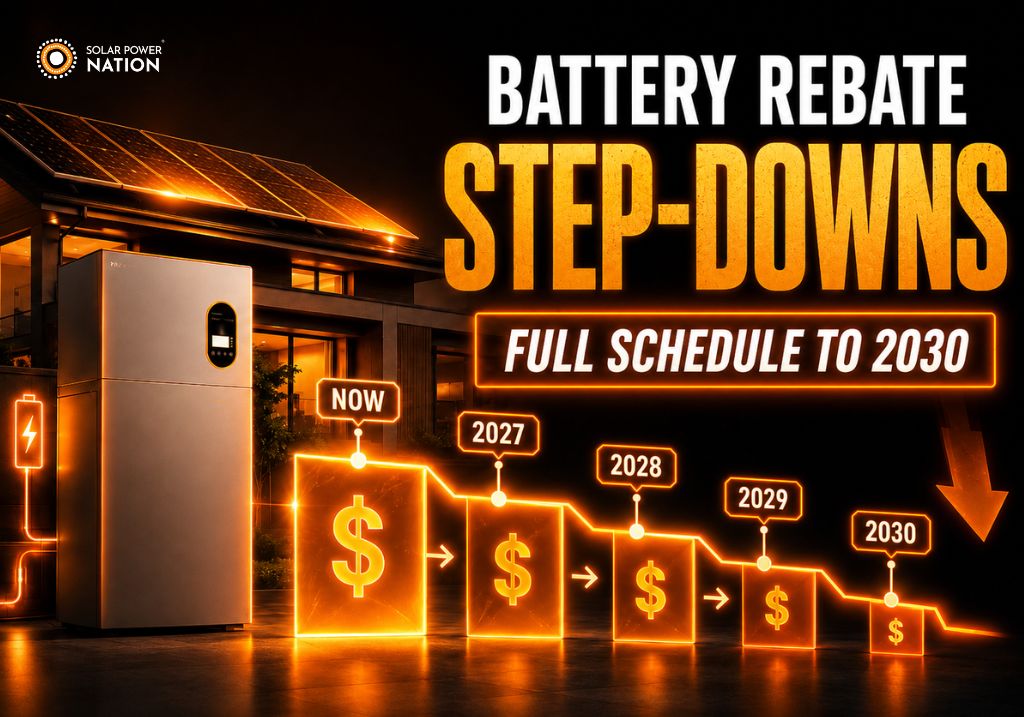
The federal Cheaper Home Batteries Program has made battery storage genuinely more affordable for Australian households — but like most incentive schemes, the rebate value isn’t fixed forever. It steps down over time, which means the amount you get knocked off the cost of a battery today can be different to what’s available in a year or two. If you’re weighing up whether to install now or wait, understanding how the step-down actually works matters more than the headline “there’s a rebate” fact.
Why Rebates Step Down Instead of Staying Fixed
Government incentive schemes for solar and storage have generally been designed to taper over time rather than stay flat indefinitely. The logic is straightforward: as the underlying technology gets cheaper to manufacture and more households adopt it, the government contribution needed to make it accessible reduces. It’s the same broad approach that was used for the original solar STC scheme, which has stepped down for years as panel costs fell.
The practical effect for anyone considering a battery is that the rebate is generally at its highest value early in the scheme’s life and reduces at set intervals from there.
How the Step-Down Structure Works
Rebate schemes of this type typically apply a per-kWh dollar value up to a certain usable capacity threshold, with a different (usually lower) rate applying to any capacity above that threshold.
Reductions to the rebate rate tend to happen on a set schedule (commonly reviewed periodically, such as every six months) rather than gradually — meaning there can be a real, dated cutover point after which a new, lower rate applies.
What This Means If You’re Deciding When to Install
Installing sooner generally locks in a higher rebate rate. If your battery decision is otherwise ready to go — you’ve picked a system, you’re happy with the quote, and the timing suits your household — there’s a genuine financial argument for not delaying past a known step-down date.
Delaying isn’t automatically the wrong call, either. If you need more time to compare batteries properly, save the deposit, or wait for a specific product to become available, a marginally lower rebate later shouldn’t push you into rushing a decision you’re not ready to make. The step-down amounts are generally incremental, not a cliff-edge that makes waiting a few extra weeks financially reckless.
Bigger systems are more exposed to the taper. Because the taper threshold means capacity above a certain point earns a lower per-kWh rebate, larger battery installs are proportionally more affected by a step-down than smaller ones. If you’re considering a large-capacity system, it’s worth modelling the rebate at both the current rate and the next scheduled rate to see the real dollar difference.
Common Misunderstandings Worth Clearing Up
The rebate isn’t a flat dollar amount regardless of battery size. It’s typically calculated per usable kWh, which means the total rebate dollar figure scales with your system size (up to the taper threshold, after which the rate reduces).
The rebate is generally applied at the point of installation, not claimed separately by the homeowner afterward — in most cases, your installer or retailer handles the paperwork and passes the discount through as a reduced upfront price.
“The rebate is ending” and “the rebate is stepping down” are different things. A step-down reduces the rate; it doesn’t necessarily mean the scheme is winding up altogether. Don’t assume urgency messaging you see elsewhere accurately reflects the scheme’s actual end date.
What to Actually Do With This Information
If you’re seriously considering a battery, the most useful next step isn’t trying to time the market perfectly around step-down dates — it’s getting a current, accurate quote that shows exactly what rebate applies to your specific system size today, so you can make a real comparison against what a delay might cost you in rebate value.
Frequently Asked Questions
How often does the battery rebate step down?
Rebate schemes of this type are typically reviewed and adjusted on a set schedule.
Will I get less rebate for a bigger battery?
Not exactly less overall — but capacity above the scheme’s taper threshold generally earns a lower per-kWh rate than capacity below it, so very large systems see a smaller rebate benefit proportionally on that upper portion.
Do I need to apply for the battery rebate myself?
In most cases, your installer or retailer handles the rebate as part of the quoting and installation process, reducing your upfront price rather than requiring a separate claim.
Is it worth waiting for a lower price instead of installing before the next step-down?
It depends on the size of your system and how far away the next step-down is. For larger systems, the rebate difference can be meaningful; for smaller systems, it’s often a modest amount that shouldn’t be the deciding factor over getting the right system and installer.
Get a Current, Accurate Rebate Estimate
Rebate figures change — don’t rely on an old number from a blog post (including, eventually, this one). Solar Power Nation can quote your exact rebate against your specific battery size, calculated at today’s rate.


