
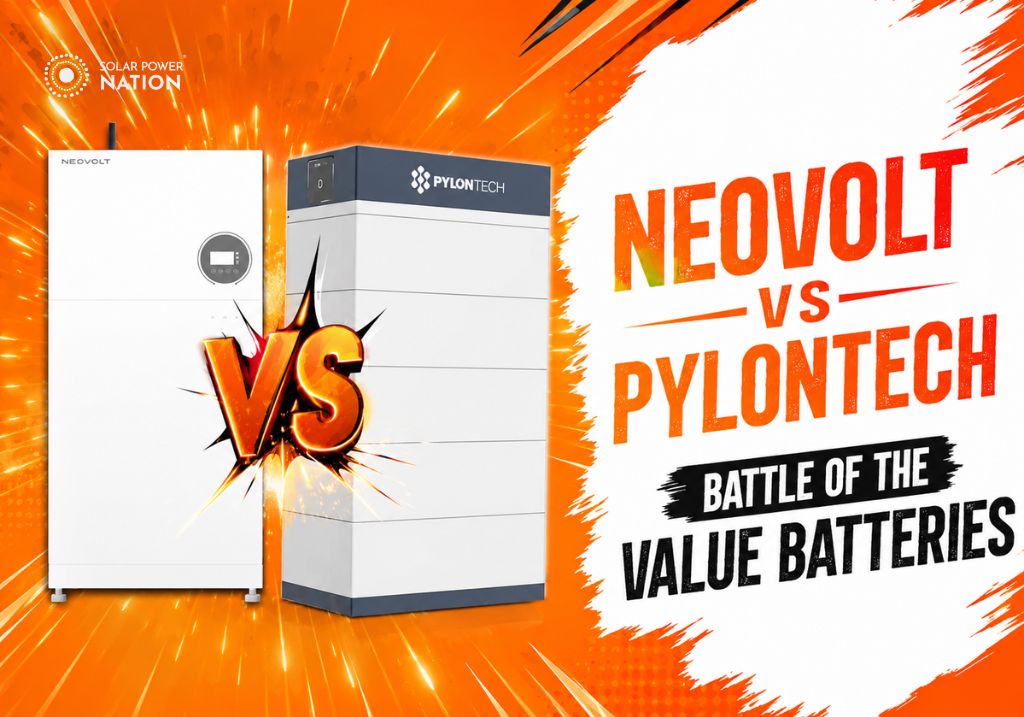
If you’ve narrowed your battery search down to the value end of the market, there’s a decent chance both of these names have come up. Neovolt is one of the newer brands making a real push into Australian homes, while Pylontech has years of installed systems behind it. Neither is a “cheap” battery in the throwaway sense — both use proven lithium iron phosphate (LFP) chemistry and are backed by real local support. The differences that actually matter are more specific than “which one’s cheaper.”
Here’s an honest side-by-side
Chemistry and Build
Both Neovolt and Pylontech use LFP cells, which is the standard most Australian installers now default to for home storage because of its thermal stability and long cycle life relative to older lithium-ion formats. On raw chemistry, there’s no meaningful difference to worry about — this isn’t a case of one brand cutting corners on cell type to hit a lower price.
Where they differ is in track record. Pylontech has been supplying the Australian market for considerably longer, with thousands of earlier-generation systems still running in homes today. Neovolt is newer to the market, which means less multi-year field data exists locally, even where the underlying engineering is sound.
Warranty and Support
Warranty terms across both brands generally sit in the same broad range as the rest of the value-to-mid market (commonly around 10 years on the product, tied to a throughput or cycle cap).
Support and servicing matter just as much as the warranty document itself. A newer brand can absolutely offer a strong warranty on paper — the real test is how quickly a local distributor or installer network can actually action a warranty claim if something goes wrong. This is worth asking directly rather than assuming from the brand’s marketing.
Price and Value
This is genuinely where these two brands compete hardest. Both are positioned to undercut premium brands like Tesla and Sigenergy while still offering a properly engineered, LFP-based system with local backing.
As a general rule: a longer-established brand’s pricing tends to reflect its track record and support infrastructure, while a newer brand’s more aggressive pricing can reflect genuinely leaner overheads — or it can simply mean the brand is still building out its local support network. Neither of those is automatically a red flag, but it’s worth understanding which one applies before you decide based on price alone.
Sizing and Compatibility
Both brands offer modular or stackable configurations that suit a range of household sizes, and both are commonly paired with popular hybrid inverter brands used across Australian solar installs. Compatibility with your specific (or planned) inverter matters more for a retrofit than for a new solar-plus-battery install, where the whole system is designed together from the start.
Which One Actually Suits You
Pylontech tends to suit: – Households that put a high value on a long, proven field track record – Retrofits onto older or less common inverter setups, where broad compatibility documentation helps – Buyers who want the reassurance of “this exact model has been running in Australian homes for years”
Neovolt tends to suit: – Households prioritising the sharpest possible price-per-kWh within a properly engineered LFP system – Buyers comfortable backing a newer brand that’s rapidly building out its Australian presence – Anyone who’s already compared premium brands and wants a genuinely lower-cost alternative without dropping to unbranded battery territory
Realistically, both are reasonable choices within the value segment of the market — this isn’t a case of one being “the real battery” and the other being a corner-cutting imitation. The right pick comes down to how much weight you put on proven history versus sharper pricing, and what your installer’s actual experience with each brand looks like on the ground.
Frequently Asked Questions
Is Neovolt a reliable battery brand?
Neovolt uses standard LFP chemistry and is backed by local distribution, but it has a shorter Australian track record than more established brands like Pylontech.
Is Pylontech better than Neovolt?
“Better” depends on what you’re optimising for. Pylontech has a longer proven history in Australian homes; Neovolt is newer but competes hard on price and specification. Neither is a clear-cut winner across every criterion.
Are value batteries as good as premium brands like Tesla or Sigenergy?
Value-segment batteries using proper LFP chemistry and backed by real local support can perform very comparably to premium brands for day-to-day bill savings and backup. Premium brands typically differentiate on design, app polish, brand recognition and sometimes marginally longer warranty terms — not necessarily on core battery performance.
How do I decide between Neovolt and Pylontech for my home?
The right choice depends on your budget, how much you value a long local track record versus sharper pricing, and what your installer recommends based on your specific inverter and usage pattern. A proper quote and sizing conversation will tell you more than any spec-sheet comparison.
Get a Straight Comparison for Your Home
Solar Power Nation carries both brands and can walk you through which one actually makes sense for your household’s usage, budget and existing setup — no pressure, no upsell.


